


 I attended an FAA safety seminar last weekend about engine failures, and it has me thinking about my personal experiences.
I experienced my only engine failure to date shortly after a night takeoff, which in my opinion is the absolute the worst time to lose confidence in your engine.
I was a relatively new student pilot and still several months away from my checkride. My instructor and I had just departed on a night cross-country flight. I was at the controls, climbing out of 1,500 feet AGL just a few miles from the airport when the engine stuttered. My instructor didn’t notice the engine’s hesitation. My attention went to the tachometer. It slid downward a second time. The plane pulled. This time she noticed. I was keenly aware that we were engulfed in a black, night sky. A highway below contained considerable traffic so wasn’t an option. If we had to put the plane down into the blackness, there would be no telling where we’d end up. There was no way to know what was inside that abyss –– farm equipment, livestock, fences, water. All were dismal landing environments.
Every ounce of my being wanted my instructor to take the controls, but she was a better teacher than that. Inspired by at least a dozen engine out drills in the months prior, my muscle memory took over. I worked the Cessna 172’s Engine Failure During Takeoff procedure from memory. Airspeed. Fuel Selector. Fuel Shutoff Valve. Mixture…
“Turn us around right now,” my instructor said. “Do it as we practiced.”
What we had practiced was flying the airplane first no matter what. I started a well-coordinated turn, cautious to not lose control by fixating on the tachometer. We were on flight following with air traffic control, so it would have been at this moment that the air traffic controller assigned to us would have noticed our 180-degree turn toward the airport on their radar. Such a deviation so soon after takeoff would be indicative of a major problem.
Once I had our runway in sight and the plane stabilized, I called approach.
“Approach, we’re returning to the field. We need priority sequence for 17L, no delay. Two souls on board, four hours of fuel.”
The controller’s training also went into action. He cleared the arrivals corridor and other aircrafts’ landing clearances. In the years I’ve been flying, I know from experience how dreadful it is to hear another aircraft in distress on the frequency. It’s a very helpless feeling to share the skies with another pilot in need.
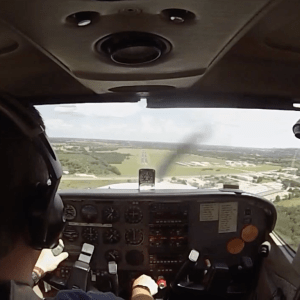
I flew a normal entry into the airport’s traffic pattern. I found the runway centerline. I read once that most partial engine failures were followed by a full failure. The clock was ticking. Pulsating runway sequence lights willed me to the airport, encouraging me to make it to the runway. I held 65 knots, and was grateful for every five seconds of power the engine gave me.
A full failure now would be merciless. We’d land … or spin … short of the runway and into a commercially zoned area. I felt some relief as we reached the point where I knew that even with a full failure I’d make the runway. After agonizingly long moments, we finally touched down. I’m grateful for my instructor’s presence that night, as well as the training she provided me in the preceding months. I’m also grateful for the controllers who helped bring us back that night.
An FAA investigator called me a day or two later, after my nerves had settled. I was unsettled. Had I done something wrong? Would my flying career be over before I had even earned my license? The investigator asked about the incident, and also asked me how I was coping with the experience. I volunteered to submit a written report of the incident.
I asked the investigator whether I needed to ground myself until the investigation was complete.
“I say whenever you get the chance to get out there and fly, you do it,” he said. Nothing here concerned him. His response gave me confidence.
The cause of the engine’s failure would later be determined to be a faulty magneto. Nothing more ever came of the situation.
In retrospect, this incident was a very valuable learning experience. While I continue to “fear” engine failures, it’s a risk that can be mitigated by training, thorough preflight inspection, and adherence to scheduled and required maintenance.
Secondly, I now have no fear or hesitation to declare an emergency for any reason. Air traffic controllers are a resource to use when help is needed. I also don’t share the same fear of the FAA that many other pilots do. I also don’t fly in ways that give me reason to be fearful of the FAA.
Here are some key considerations for engine failures:
- Fy the plane first. Remember, ABC: Airspeed, Best Landing Area, Checklist.
- If on a final approach with questionable power, preserve as much speed as possible. It’s better to land long and overshoot the runway than it is to stall and spin short of the run.
- Engine failures aren’t binary. You can have an intermittent failure, gradual failure, partial failure. Be prepared for any combination of these.
- Work with your instructor on simulated failures and no-power landings near the airport.
 Michael Castellon