Tag: personal

  • Flight Training Journal for May 15

    On Saturday I met George at Atlantic at 430pm, where we chatted for about a half hour while waiting for our Cessna 172 to arrive from a training flight. We went over some of the training books I purchased. The older, bound copy of Jeppesen’s Private Pilot Manual is perfectly adequate, except for the Charts section, which is very dated.

    My Operating Handbook for the 1976 Cessna 172M Skyhawk is relevant, as the aircraft I’m training on, a Cessna 172, is a 1977 model, is similar in operations.

    We met 3CP upon its arrival, parking and debrief from another student pilot and instructor.

    We conducted our walk-around of the plane, checking rivets, body structure, the bolts and nuts within the flap, aileron, and trim mechanisms, the tires, pitot tubes, static devices and propeller.

    We did our pre-start checklist, checking gauges, power, oil and fuel levels and gauges, controls and radios. Air traffic seemed minimal at Bergstrom at this hour, aside from a few Southwest flights and general aviation aircraft puttering in and out.

    We were directed by Austin Ground to Runway 35 Right, and were instructed to hold short of the runway while two planes made their approach, one being a very majestic Navy T-45 trainer.

    We did our run-up, briefly pushing the engines to 1700 RPM and cycling the Magnetos to check for a slight RPM drop.

    We did one more check of our instruments and controls, closed and locked our windows and were soon cleared for takeoff.

    George gave me control of the takeoff. We climbed to 3,000 feet and turned east to a training area near Bastrop. The aircraft felt good to me; We didn’t experience as many thermals and other chop on our previous flight.

    I have a tendency to favor watching vertical speed over airspeed. This is a bad habit I established from my experience on simulators, where I didn’t have an instructor present to correct me. Favoring airspeed is important especially during takeoff and ascent, for obvious reasons.

    George had me do a number of turns, beginning with simple, level flight turns at 3,000 feet. The goal was to discipline me to proper coordination of the rudder and ailerons.

    Following that I was instructed through a number of ascending- and descending- turns. For an ascending turn, I would pitch the aircraft up at full power with a rich mixture, then bank 30 degrees while maintaining proper rudder and aileron control according to the turn indicator.

    This maneuver is tricky considering that I now have to watch several aspects at once ­­–– pitch, yaw, airspeed, roll, outside traffic ­­–– while maintaining proper speed.

    We followed up with a number of descending turns where I would throttle back, and bank 30 degrees, and make a full 360 degree turn that resembled a wide, downward spiral.

    After doing a number of wide ascending- and descending-turns, George had me pitch the plane up steeply while bringing our speed back to 40 knots. This low speed and high pitch bring the aircraft to a near-stall. The goal is to train me to recognize the noise levels of the engine and wind while also feeling the attitude of an aircraft that is nearing a stall. At such a steep pitch, I had to control our altitude by throttle – which created a new sensation of feedback from the aircraft.

    George’s goal for me is to make control of the rudder more instinctive. Applying rudder pressure for any turn needs to be second nature, just as turning the yoke is.

    To reinforce this point, I was instructed to fly the airplane back to Bergstrom with just the rudders and throttle with my hands off the yoke.

    Banks and turns, to my surprise, can be conducted solely with rudder pedals, at least in the Cessna 172. Hard pressure on either rudder pedal could roll us into a turn, out of a turn, and into level flight. After five or ten minutes of flying just by throttle and rudder, the re-introduction of the ailerons and elevators felt like an unnecessary but welcome luxury.

    We made our approach on Runway 35R and made a routine landing and taxi back to General Aviation.

    I debriefed with George, gave him some feedback and comments, and he did the same.  One of his goals for me is to focus more outside of the aircraft; I have a tendency to hyper-focus on instruments and controls, rather than using visual cues given to me by the horizon and relative aircraft position.  Getting my mind and eyes outside of the cockpit will better help reinforce the habit of watching for other aircraft in our area, especially during time when we’re flying VFR without oversight from the Center.
  • Tim O’Reilly on digital rights management and e-books

    Via Forbes:

    People who don’t pay you generally wouldn’t have paid you anyway. We’re delighted when people who can’t afford our books don’t pay us for them, if they go out and do something useful with that information … There’s a bakery in Berkeley that every day dumps a lot of fresh bread into a dumpster behind the store. And there’s a bunch of people who get their bread there. I guarantee you that there are a lot more people who, even if you told them they could, would not do that. A lot of sources of free content are like going rooting through the dumpster.

  • The Guardian: 10 years of the iPod

    Great retrospective piece on the iPod from inception to date. This raises the question of whether the iPod it set to be retired this year:.

    Steve Jobs, a Bob Dylan fan who once dated the singer’s ex, Joan Baez, insisted that people wanted to own their music, not rent it. They had collected vinyl, cassettes and CDs in the past and they would collect digital music in the future. One by one, Jobs managed to talk the big five major labels into signing up to his vision. “Jobs’s stock went from $8bn to $80bn,” recalls one music executive. “Ours went in reverse.” Sony, in particular, was hamstrung. On the one hand its hardware division wanted to push a Walkman that would compete with the iPod. On the other, its record label, Sony Music, accounted for the majority of its revenues and was unwilling to push forward with something they thought would be filled with illegally downloaded music. Paralysed, Sony allowed Apple to clean up on both the digital device and the songs to play on it.

  • Our SXSW 2011 Presentation on Visualizing Government Data is now online [Updated]

    Our panel at SXSW 2011 was a great experience, thanks largely to an outpouring of engagement from government professionals and contractors. Our hashtag is still active on Twitter.

    As promised, I’ll answer questions as they come in via the hashtag #visualgov. Or, just e-mail me if you’d like to discuss something in private.

    Here’s the link to our slides.

    Update: Audio of the talk is now available.

    [podcast]https://michaelcastellon.net/wp-content/uploads/2011/03/Why-Visualizing-Government-Data-Makes-Taxpayers-Happy.mp3[/podcast]

    Direct audio download

    Subscribe in iTunes

  • My SXSW 2011 Panel: Visualizing Government Data for Public Trust

    I’ll be on a panel next Saturday at SXSW 2011 titled Why Visualizing Government Data Makes Taxpayers Happy.

    I’m really hoping to see a lot of people from local, state and federal government at SXSW this year. This is a great year for public sector employees attending the conference.

    Here are a few of the things I’m going to discuss with my co-panelist and friend @jeremiahakin:

    • Why open data is important to government transparency and earning the public’s trust
    • How the federal government has served as a model
    • How agencies can distribute data visualization across teams, often to non-technical workers.
    • What tools agencies and other organizations can use to adopt similar strategies
    • The value and risks associated with various file formats, including Fusion Table and Google Earth.
    • Upcoming data visualization trends

    My Schedule is a work in progress. Talk to me on Twitter if you’re attending SXSW 2011.

  • 2011 MacBook Pro upgrade

    I’ve written before about customer service at the Apple Store here in Austin. Here’s another experience worth sharing.

    On Jan. 22 I bought a 13″ 2010 MacBook Pro at The Domain. Earlier this week, the new MacBook Pro models were announced. I was impressed enought with the new models — especially the Thunderbolt i/o and i5 processor contained in the 13″ model — to take a chance and call the Apple Store about an exchange.

    Without any hesitation, they agreed to exchange my 2010 Pro for the newer 2011 model. No questions, no fees, just an even swap. I was out of the store in 10 minutes, which was an added bonus as I’m currently fighting a virus.

    The new machine is a nice step up for the MacBook Pro line. Big thanks to the managers and staff at The Domain’s Apple Store for always being of assistance.


  • 2011 MacBook Pro details leaked?

    These images are convincing, and the specs sound about right.

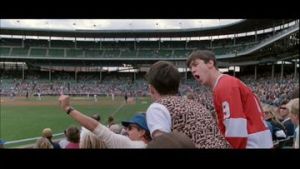
  • Ferris Bueller’s Wrigley Field scene explored

    In Cubs Nation there’s been some confusion and bickering regarding exactly when in 1985 the cast and crew of Ferris Bueller’s Day Off shot the scene at Wrigley Field.

    Fortunately, Ken Collins, who served as second assistant director for the shooting, responded to a request from Al Yellon to clarify the situation:

    I was the second assistant director on the movie. That’s me sitting in front of Ferris and Cameron wearing Raybans and a Cub cap. I put myself into the scene as an extra. Being an L.A. guy, I had wanted to wear a Dodger cap but John Hughes said no way! We started our shooting in Chicago on September 9, 1985.

    We definitely were at Wrigley on a game day. We started around 10am filming actor closeups and dialogue with a bunch of our extras in a specially designated part of the bleachers. When the game started, we grabbed some shots over the actors connecting them to the game and then we pulled out and moved up the street a couple of blocks to continue filming another scene. We left a camera behind to pick up some miscellaneous shots. We were close enough to the stadium to hear the crowd roaring and a lot of us continued to listen to Harry call the game. It got colder and windier and the game turned into a typical Wrigley slugfest where over 30 runs were scored. I’m pretty sure that the game was played on Sept. 24, 1985 and the Cubs lost to the Expos 17-15.

    We filmed the famous Danke Shoen-Twist and Shout sequence at the Von Steuben’s Day parade on the following Saturday.

    So that settles it.