Here’s the Center for Disease Control and Preventions extensive advice on using Twitter and making content viral. Puns intended.
CDC Twitter policy http://d1.scribdassets.com/ScribdViewer.swf


Here’s the Center for Disease Control and Preventions extensive advice on using Twitter and making content viral. Puns intended.
CDC Twitter policy http://d1.scribdassets.com/ScribdViewer.swf
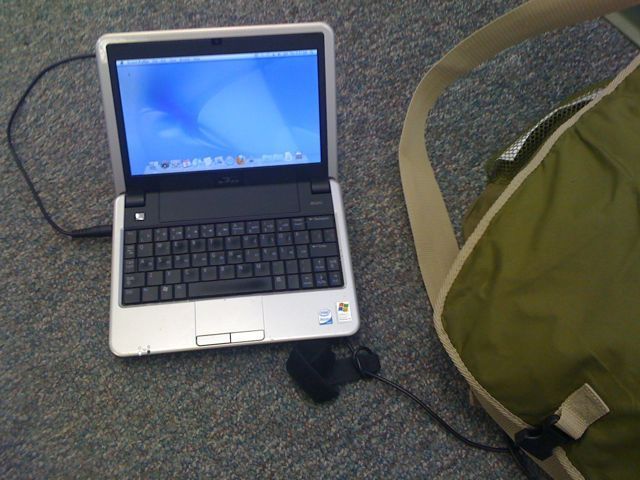
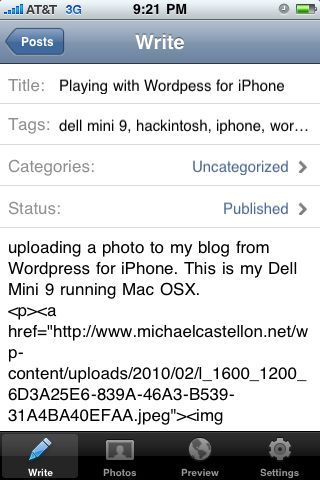
uploading a photo to my blog from WordPress for iPhone. This is my Dell Mini 9 running Mac OSX.
 When social media tools and techniques are applied to government communications, agencies are able to meet the obligation of transparency and “open books” initiatives in ways that were impossible to imagine just a few years ago.
One of the tricky things about overseeing social media initiatives is introducing tried and true marketing, public relations, and editorial techniques into a realm that is chaotic, unpredictable, and often unforgiving to missteps.
As if that wasn’t challenging enough, government transparency increasingly is becoming the responsibility of staffers from a variety of disciplines and positions outside of public relations; Web developers, writers, editors, and content managers all play a large roll. Where we once created static documents and pitched media, our jobs are expanding toward not only spurring discussion, but also participating in it.
A strong social media plan and policy is critical to success.
Jeff Levy, director of Web communications at the EPA’s Office of Public Affairs, was kind enough to share with me his agency’s social media policy.
Jeff’s shop has developed a terrific flow-chart that adds a visual methodology of determining when and how to participate in online discussions. Also check out the EPA’s social media guidelines. Both documents are well worth examining.
Kudos to Jeff and his team at the EPA.
Flow Chart http://d1.scribdassets.com/ScribdViewer.swf
Interim Guidance Representing EPA Online FInal http://d1.scribdassets.com/ScribdViewer.swf
 It’s been a few weeks since I got an Amazon Kindle as a gift from my wife. Here’s a quick and hastily written review of the device based on my experience thus far.
1. Portability
I went to West Texas to visit family over Christmas. I brought six books, three magazines and several newspapers with me on a device just a little bit bigger than a DVD case. I travel quite a bit, so it’s great to carry books, magazines, and blogs with me without eating up a lot of physical space. In terms of virtual space, Kindle can hold up to 1,500 books.
2. Selection of Titles
This took me by surprise. Amazon says they stock just under 400,000 e-books in their Kindle Store. So far, every book I’ve searched for has a Kindle edition, usually priced around $8. Titles are delivered straight to the device in about 15 seconds. I can shop for new content directly from the device.
3. Internet
Kindle includes a lifetime subscription to 3G wireless that Amazon is entitled to change on a whim, according to their TOS. So far, I’ve had a good connection to the cellular networks that tether the Kindle. The device has a simple, built-in browser. The browser’s display isn’t very pretty — it resembles cell phone Web browsing from 2003. Regardless, I can easily check my Gmail, access Wikipedia, or read CNET and Slashdot from the Kindle with little effort
4. Ruggedness
Kindle is less than two inches thick and weighs about 10 ounces. While I wouldn’t take it to the beach, I wouldn’t have a problem taking it camping or carrying it in my backpack to read on my lunch break or on a layover. Sadly, the newest generation Kindle doesn’t include a case, but you can pick one up on Amazon for about 30 bucks.
5. Readability
My biggest fear was that I wouldn’t like reading the Kindle. How pleasurable can a digital screen be? I was surprised that Kindle’s display allows for easy reading. I’ve noticed that reading in low-light can be problematic, more so than with a printed book.
6. Free Stuff
Amazon offers quite a few free titles. There are also a lot of Web sites and blogs that specialize in connecting Kindle users with free content. My favorite is the Gutenberg Project.
7. Battery Life
I go four to six days before I need to charge. At this point, I can get a very solid charge in an hour or two. Battery life is greatly improved with wireless connectivity turned off.
The Not So Good
Navigation on the Kindle is clunky and a little slow. It’s easy to reach the Home screen, which is where you find your list of titles, but navigating indexes of newspaper stories and book chapters is not very intuitive. I expect this to improve quite a bit in future iterations.
DRM. This is a big one for me. I celebrated when Apple removed DRM from the iTunes Store, giving customers freedom to move their purchased audio tracks around as they see fit without the restrictions of Digital Rights Management. It bothers me that Amazon could potentially remove purchases from my device or monitor what and how I read.
Paying for Blogs. This one really sucks. Kindle users can subscribe to blogs for .99 each per month. I read dozens of blogs daily. The idea that I have to pay to have this otherwise free content sent to my device is ridiculous. One way around this is to bookmark Google Reader in your Kindle’s Web browser, but navigation is still pretty lame.
Overall, the Kindle is a great device. A few glitches aside, I really like what it does.
We spent the day Christmas shopping at the Domain. It doesn’t quite feel like a recession at stores like Macy’s, Borders and many of the boutiques.
Sales can be found just about everywhere, with the exception of the Apple Store, where bustling customers greedily snatched up iPhones and accessories.
We’re very near being finished with all of our shopping, with this year being about half on-site shopping and the rest online.
I rewarded myself for not having any crowd-induced breakdowns and purchased a WhirlyPop popcorn maker that was quickly broken in. Not a single unpopped kernal.
Before there were tech hipsters, there were tech hippies. Both are a major part of a documentary available on Hulu.
MacHeads is a film about the cult aura that has surrounded the Apple brand from its inception in the 1980s, its fall in the 1990s, and its grand rebirth at the turn of the new century.
The film features fanatical Mac users. Not Mac-fanatics like the graphic designer at your office who always has the latest iPod and a ‘Think Different’ poster in his cubicle … More like the “I have a digital belt buckle that pays homage to Steve Jobs and I’m standing outside the Moscone Center at 4 a.m. waiting for MacWorld Expo to open” type user.
The film isn’t especially concise, but what I did enjoy, aside from vintage newsreel of MacWorld events, was some interesting exploration into how Steve Jobs and, most notably, Guy Kawasaki, managed fan/user communities and media at various times throughout the company’s history.
Check it out.
 My parents divorced when I was 10, and like every child who goes through such a thing, I was devastated.
My dad soon fell into the safety of a new family and, for the most part, out of my life.
While my mother often did the best she could under her circumstances, financial and emotional turmoil followed us from one apartment to the next.
Friendships were torn away every time we moved, and the ritualistic hazing that comes with being the new kid in the neighborhood became a permanent thing. To make matters worse, my mother’s live-in boyfriend had become so abusive to me that I spent the ages of 12 to 15 covered in hives.
As a result, much of my childhood was spent lonely and isolated. Like many children do in these situations, I retreated into my imagination, which became increasingly vivid and complex as the world around me became more difficult. I consumed books, video games, magazines and the fantasy of “other places” –– anywhere but here.
For these reasons I’m excited to see Spike Jonze’s film adaptation of Maurice Sendak’s classic children’s book, Where the Wild Things Are.
Even now, as distanced as I am from that early pain, I identify well with Max, who, in perhaps one of the most epic acts of escapism, dons a set of wolf pajamas, leaps into his fantasies and conquers his own fear, anger and confusion toward the outside world.
Sendak knows that children are braver than we give them credit. He also knows that we often take for granted their heightened sense of emotion and wonder, that the boundless joy and fun they feel for beautiful things also works the other way –– that pain stings more when it’s new.
So tonight I’m looking forward to seeing Wild Things, and perhaps in my own act of escapism, spending the rest of the weekend in my pajamas with my imagination.
 Michael Castellon