"The space shuttle Endeavour and International Space Station shine front and center in this amazing (and historic) photo of the two vehicles docked together as seen from a Russian Soyuz spacecraft. Astronaut Paolo Nespoli snapped this view and others during the first-ever photo session of a shuttle docked at the space station".
-
Flight Training Journal for June 4
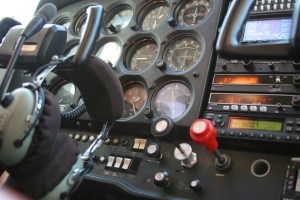
The FAA’s Airplane Flying Handbook instructs pilots to spend about 80 percent of their sight-time out of the cockpit, observing air traffic and flight characteristics. Accordingly, only 20 percent of time should be spent observing instruments.Today, while practicing this I began to feel the awe of flight, how beautiful it is to see the world from so far above. It’s a view that is truly earned.
After a week off for travel, it was nice to be back in the cockpit with George. The heat was extraordinary today, even by any Texas standards. George is easing off my pre-flight inspection, leaving responsibility of it almost entirely up to me. How well a plane is inspected during pre-flight dictates the likelihood for in-flight surprises –– Rivets are checked alongside flap hinges, tire wear and pressure, flight controls and other elements. An oversight during pre-flight inspection can be costly.
George made himself busy elsewhere while I performed the pre-flight walk-around, removed tie-downs, and examined the plane. This is especially humbling and reassuring as it serves as a marker of my progress and the trust I’ve built with him.
The tarmac and the plane are blistering hot. Once the cockpit doors are closed, the temperature in the plane can climb by 20 degrees and more. We moved through the checklists quickly, started the engine and got moving. The airport’s General Aviation traffic was light. We didn’t contend with much ground traffic and made a fast taxi to our position.
I’m comfortable taxing the airplane, which George delegates to me. I remained comfortable even with private jets in front of and behind us. Taxing isn’t especially difficult compared to flying, but there’s a certain style and grace good pilots demonstrate while taxing an airplane. It’s a sophisticated balance of speed, knowledge of runway markers, and awareness of ground traffic.
Following our run-up, which is basically a last minute check of the engine’s performance, magneto functioning, fuel tank configuration, and check of the cockpit doors and locks, we were directed to line up and wait at Runway 17L, a deviation from the usual 35R departures I’m accustomed to. As the runway’s number designation implies, Runway 17L is on a heading of 174 degrees, just a few degree off Due South.
I did an unassisted takeoff, and the ground effects of the day’s heat were immediately apparent. We hit some low- to moderate-turbulence caused by thermals––pockets of warm air that unexpectedly push the aircraft up, with a resulting drop.
We headed east toward Bastrop, where George observed me perform about six steep, 360-degree turns. The turns are a little more exciting in conjunction with the thermals.
Flight controls take on unique characteristics during steep turns. Having the push and bounce of flight thermals underneath the plane adds a level sport and excitement that I’m beginning to appreciate more and more.
Performing a steep angle turn requires a pilot to hold an uncomfortably tight turn, with the aircraft almost on its side. With the plane in such a position, its ability to hold attitude is compromised, and the pilot must pull back on the nose to keep it at or just slightly above the horizon, which holds a consistent altitude when performed properly. Like taxing, it’s a maneuver that is simple to perform, but to perform well is a delicate art.
Stalls and Stall Recovery
A stall occurs when the angle-of-attack on the wings becomes so great that lift is no longer supporting the plane in the air. If not corrected, a stall will force an aircraft out of the sky. Imagine what happens when you toss a paper airplane and it flies upward to the point that it stops, hangs and falls out of the air. This is a stall.
Leading up to the stall, George instructed me to throttle back, and we dropped our flaps one notch at a time putting the plane at about 40 knots, which is uncomfortably slow for my experience level. As we slow to below 40 knots, the plane starts to buffet and the controls get very sloppy, bordering on unresponsive. A horn in the cockpit alerts us that there is improper air flow beneath or wings. As the plane shakes, the Cessna’s nose dips. Instinct tells a student that when the aircraft’s nose dips, back pressure must be applied to the yoke to correct its position. This response, however, aggravates and worsens the stall, highly compounding the problem. Pulling back during a stall is exactly what a pilot must not do.
To correct the stall, I quickly applied full throttle, increased our flaps by one notch (or 10 degrees), and applied right rudder to compensate for the quickly induced torque of the propellor. Following that, one notch of flaps is raised incrementally until a controllable airspeed is reached. George observed me perform four stalls and subsequent recoveries.
This skill, I’m reminded, will be paramount as we move closer to practicing landings, as stalls must be recovered from especially quickly at low altitudes.
-
Flight Training Journal for May 22
A very large part of strengthening one’s airmanship is rooted in decision-making. Decisions are often made long before a pilot enters an aircraft.I was scheduled in the 172 this morning for two hours of stall training and spin- and stall-recovery. I left home this morning at 8am and had a bad gut feeling when the overcast skies had failed to burn off. By the time I was approaching Bergstrom, a thick black patch of cloud hung over the horizon. Just around the corner from General Aviation, George rang my phone. I knew we weren’t going to be flying.
Not only were the clouds too low, there was a chance of thunderstorms throughout the area. The conditions just weren’t right for practicing stalls. I was disappointed.
On the brighter side, not flying today gave me more time with my reading chapters. I’ve spent a lot of time the last week visualizing stalls and stall recoveries — releasing back pressure on the controls, slowly throttling up to full, and offsetting propellor torque with a healthy push of right rudder. The Airplane Flying Handbook provides informative, concise information on stalls and stall recoveries.
To make up for the time I missed in the cockpit I spent two hours on the simulator. I recreated conditions we typically fly in, and practiced standard rate turns during ascent and descent, and also did a few stall recoveries. One of the many assets of the 172 is its ability to recover from stalls. The 172 will buffet, and the controls will get very sloppy while entering the stall. If the pilot executes the proper steps, the plane while slide right into a normal attitude and speed, with a functional angle of attack on the wings. Failing to execute properly, of course, can result in a spin.
My reading list has expanded to include Paul E Illman’s The Pilot’s Radio Communications Handbook. The text explores common communication failures, managing transponders, and radio failure procedures.
I’m working on getting a two hour slot in the 172 later this week, weather permitting. Even while grounded, though, there’s plenty of reading to do.
-
Flight Training Journal for May 15
On Saturday I met George at Atlantic at 430pm, where we chatted for about a half hour while waiting for our Cessna 172 to arrive from a training flight. We went over some of the training books I purchased. The older, bound copy of Jeppesen’s Private Pilot Manual is perfectly adequate, except for the Charts section, which is very dated.My Operating Handbook for the 1976 Cessna 172M Skyhawk is relevant, as the aircraft I’m training on, a Cessna 172, is a 1977 model, is similar in operations.
We met 3CP upon its arrival, parking and debrief from another student pilot and instructor.
We conducted our walk-around of the plane, checking rivets, body structure, the bolts and nuts within the flap, aileron, and trim mechanisms, the tires, pitot tubes, static devices and propeller.
We did our pre-start checklist, checking gauges, power, oil and fuel levels and gauges, controls and radios. Air traffic seemed minimal at Bergstrom at this hour, aside from a few Southwest flights and general aviation aircraft puttering in and out.
We were directed by Austin Ground to Runway 35 Right, and were instructed to hold short of the runway while two planes made their approach, one being a very majestic Navy T-45 trainer.
We did our run-up, briefly pushing the engines to 1700 RPM and cycling the Magnetos to check for a slight RPM drop.
We did one more check of our instruments and controls, closed and locked our windows and were soon cleared for takeoff.
George gave me control of the takeoff. We climbed to 3,000 feet and turned east to a training area near Bastrop. The aircraft felt good to me; We didn’t experience as many thermals and other chop on our previous flight.
I have a tendency to favor watching vertical speed over airspeed. This is a bad habit I established from my experience on simulators, where I didn’t have an instructor present to correct me. Favoring airspeed is important especially during takeoff and ascent, for obvious reasons.
George had me do a number of turns, beginning with simple, level flight turns at 3,000 feet. The goal was to discipline me to proper coordination of the rudder and ailerons.
Following that I was instructed through a number of ascending- and descending- turns. For an ascending turn, I would pitch the aircraft up at full power with a rich mixture, then bank 30 degrees while maintaining proper rudder and aileron control according to the turn indicator.
This maneuver is tricky considering that I now have to watch several aspects at once –– pitch, yaw, airspeed, roll, outside traffic –– while maintaining proper speed.
We followed up with a number of descending turns where I would throttle back, and bank 30 degrees, and make a full 360 degree turn that resembled a wide, downward spiral.
After doing a number of wide ascending- and descending-turns, George had me pitch the plane up steeply while bringing our speed back to 40 knots. This low speed and high pitch bring the aircraft to a near-stall. The goal is to train me to recognize the noise levels of the engine and wind while also feeling the attitude of an aircraft that is nearing a stall. At such a steep pitch, I had to control our altitude by throttle – which created a new sensation of feedback from the aircraft.
George’s goal for me is to make control of the rudder more instinctive. Applying rudder pressure for any turn needs to be second nature, just as turning the yoke is.
To reinforce this point, I was instructed to fly the airplane back to Bergstrom with just the rudders and throttle with my hands off the yoke.
Banks and turns, to my surprise, can be conducted solely with rudder pedals, at least in the Cessna 172. Hard pressure on either rudder pedal could roll us into a turn, out of a turn, and into level flight. After five or ten minutes of flying just by throttle and rudder, the re-introduction of the ailerons and elevators felt like an unnecessary but welcome luxury.
We made our approach on Runway 35R and made a routine landing and taxi back to General Aviation.
I debriefed with George, gave him some feedback and comments, and he did the same. One of his goals for me is to focus more outside of the aircraft; I have a tendency to hyper-focus on instruments and controls, rather than using visual cues given to me by the horizon and relative aircraft position. Getting my mind and eyes outside of the cockpit will better help reinforce the habit of watching for other aircraft in our area, especially during time when we’re flying VFR without oversight from the Center.
-
Google I/O Extended
I spent a good part of the day attending Google I/O Extended in Austin. Attendees saw some interesting talks from app developers like Spanning Backup and BoozeHound. We watched remote video feeds of the Google I/O keynotes in San Francisco. Google offices are just what you expect — colorful and vibrant.
-
Tim O’Reilly on digital rights management and e-books
People who don’t pay you generally wouldn’t have paid you anyway. We’re delighted when people who can’t afford our books don’t pay us for them, if they go out and do something useful with that information … There’s a bakery in Berkeley that every day dumps a lot of fresh bread into a dumpster behind the store. And there’s a bunch of people who get their bread there. I guarantee you that there are a lot more people who, even if you told them they could, would not do that. A lot of sources of free content are like going rooting through the dumpster.