


Tag: personal
-
Details of Amazon’s Kindle Tablet
 Just before the Labor Day weekend, TechCrunch’s MG Siegler went hands-on with a prototype of the upcoming Amazon Kindle tablet. Siegler writes that the color tablet will feature a deeply branded reboot of the Android OS. Amazon is eyeing a November release, according to the report.
Again, the device is a 7-inch tablet with a capacitive touch screen. It is multi-touch, but from what I saw, I believe the reports that it relies on a two-finger multi-touch (instead of 10-finger, like the iPad uses) are accurate. This will be the first Kindle with a full-color screen. And yes, it is back-lit. There is no e-ink to be found anywhere on this device.
I’m a huge fan of the Kindle for two reasons. The first being that it’s neatly tied to Amazon, allowing me to purchase content and send it directly to the device, or access it through my iPhone or through the new Web-based reader. Second, e-Ink is incredibly readable; It’s far more easy to read for extended lengths than my iPad’s screen. It will be a shame if the Kindle Tablet doesn’t retain that level of readability. Expect leaked images of the prototypes screen at any time.
-
Woman scammed by wooden iPad salesmen
Via The Smoking Gun:
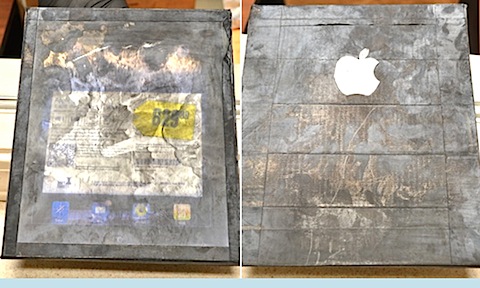
Ashley McDowell, 22, told deputies that she was approached by two black males who claimed to have purchased iPads in bulk and were selling them for $300 apiece. After McDowell explained that she only had $180, the duo agreed to sell her the device at a cut rate. But when McDowell drove home and opened the FedEx box containing the iPad, she instead discovered the wood with the Apple logo. The “screen”–which was framed with black tape–included replicas of iPad icons for Safari, mail, photos, and an iPod.
-
Siracusa’s excellent Lion review
In the same way that Mac OS X so clearly showed the rest of the industry what user interfaces would look like in the years to come, Apple’s own iOS has now done the same for its decade-old desktop operating system. iOS was less shocking to users because it appeared to come from nothing, and the mobile operating system conventions it defied were ones that nobody liked anyway. The same is not true on the desktop, where users cling like victims of Stockholm syndrome to mechanics that have hurt them time and again.
It may be many years before even half of the applications on a typical Mac behave according to the design principles introduced in Lion. The transition period could be ugly, especially compared to the effortless uniformity of iOS. In the meantime, let Apple’s younger platform serve as a lighthouse in the storm. The Mac will always be more capable than its mobile brethren, but that doesn’t mean that simple tasks must also be harder on the Mac. Imagine being able to stick a computer neophyte in front of an iMac with the same confidence that you might hand that neophyte an iPad today.
-
Flight Training Journal for June 11: Landings

Today’s flight begins just after 8 am. CFI Dakota Zigrang is in the right seat covering for George, who has a scheduling conflict. I preflight our plane, N733CP, and get a quick lesson from Dakota in visually checking fuel levels in each wing tank; this requires a remarkably ungraceful and awkward climb up on top of the wing, where I imagine my presence as being wildly comical to anyone who happens to be watching from afar, akin to a shaved guerilla balancing on a beach ball.
Dakota designates me as pilot-in-command and leaves to me the decision whether to fly with a well-worn right tire. Per the FAA Handbook, the tire is still airworthy until its steel radial strips are visible and exposed. I tell Dakota that I’m comfortable flying with the worn tire, and we resume our preflight. I’m on the radios, obtaining Ground/Clearance, squawk code, taxi instructions, and departure headings. My radio communications are still choppy, but I’m making great strides compared to several weeks ago.
After a quick taxi we takeoff from KAUS from Runway 17L and experience relatively smooth flying up to 3,000 feet. Our aircraft isn’t configured for IFR flight, so Dakota directs me to slalom through some unexpected cloud cover that crept up on us by surprise. By keeping our aircraft out of the clouds, we remain visible to other aircraft in the area.
We enter the traffic pattern at Lockhart with relative ease despite there being some other traffic in the area. Dakota keeps a light touch on the controls, but trusts me to bring us in on the small airfield. Clean, precise landings depend on the proper sequence of events: Enter the approach downwind, throttle back to about 1700 RPM to bleed-off speed, dropping flaps by 10-degree increments until established on final, and keeping the nose positioned slightly downward while making base leg and turn-to-final to avoid stalls.
Dakota helps me understand the need to visually focus on the runway numbers, eventually setting the aircraft down directly on top of the paint. After flaring, touching down, and applying brakes, I experience some difficulty remembering to maintain firm back pressure on the controls to prevent stress (and buffeting) on the nose wheel’s suspension during our landing roll.
After clearing the runway, we “clean up” the airplane’s configuration by adjusting mixture to two fingers, putting our flaps up and turning off our landing lights. We taxi, takeoff and go several more times before making a smooth flight back to KAUS. We enter the pattern for 17L, and are cleared for a number two landing behind Continental commuter jet, requiring us to keep a safe distance in order to avoid its wake turbulence.
-
Flight Training Journal for June 4
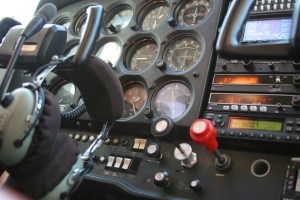 The FAA’s Airplane Flying Handbook instructs pilots to spend about 80 percent of their sight-time out of the cockpit, observing air traffic and flight characteristics. Accordingly, only 20 percent of time should be spent observing instruments.
Today, while practicing this I began to feel the awe of flight, how beautiful it is to see the world from so far above. It’s a view that is truly earned.
After a week off for travel, it was nice to be back in the cockpit with George. The heat was extraordinary today, even by any Texas standards. George is easing off my pre-flight inspection, leaving responsibility of it almost entirely up to me. How well a plane is inspected during pre-flight dictates the likelihood for in-flight surprises –– Rivets are checked alongside flap hinges, tire wear and pressure, flight controls and other elements. An oversight during pre-flight inspection can be costly.
George made himself busy elsewhere while I performed the pre-flight walk-around, removed tie-downs, and examined the plane. This is especially humbling and reassuring as it serves as a marker of my progress and the trust I’ve built with him.
The tarmac and the plane are blistering hot. Once the cockpit doors are closed, the temperature in the plane can climb by 20 degrees and more. We moved through the checklists quickly, started the engine and got moving. The airport’s General Aviation traffic was light. We didn’t contend with much ground traffic and made a fast taxi to our position.
I’m comfortable taxing the airplane, which George delegates to me. I remained comfortable even with private jets in front of and behind us. Taxing isn’t especially difficult compared to flying, but there’s a certain style and grace good pilots demonstrate while taxing an airplane. It’s a sophisticated balance of speed, knowledge of runway markers, and awareness of ground traffic.
Following our run-up, which is basically a last minute check of the engine’s performance, magneto functioning, fuel tank configuration, and check of the cockpit doors and locks, we were directed to line up and wait at Runway 17L, a deviation from the usual 35R departures I’m accustomed to. As the runway’s number designation implies, Runway 17L is on a heading of 174 degrees, just a few degree off Due South.
I did an unassisted takeoff, and the ground effects of the day’s heat were immediately apparent. We hit some low- to moderate-turbulence caused by thermals––pockets of warm air that unexpectedly push the aircraft up, with a resulting drop.
We headed east toward Bastrop, where George observed me perform about six steep, 360-degree turns. The turns are a little more exciting in conjunction with the thermals.
Flight controls take on unique characteristics during steep turns. Having the push and bounce of flight thermals underneath the plane adds a level sport and excitement that I’m beginning to appreciate more and more.
Performing a steep angle turn requires a pilot to hold an uncomfortably tight turn, with the aircraft almost on its side. With the plane in such a position, its ability to hold attitude is compromised, and the pilot must pull back on the nose to keep it at or just slightly above the horizon, which holds a consistent altitude when performed properly. Like taxing, it’s a maneuver that is simple to perform, but to perform well is a delicate art.
Stalls and Stall Recovery
A stall occurs when the angle-of-attack on the wings becomes so great that lift is no longer supporting the plane in the air. If not corrected, a stall will force an aircraft out of the sky. Imagine what happens when you toss a paper airplane and it flies upward to the point that it stops, hangs and falls out of the air. This is a stall.
Leading up to the stall, George instructed me to throttle back, and we dropped our flaps one notch at a time putting the plane at about 40 knots, which is uncomfortably slow for my experience level. As we slow to below 40 knots, the plane starts to buffet and the controls get very sloppy, bordering on unresponsive. A horn in the cockpit alerts us that there is improper air flow beneath or wings. As the plane shakes, the Cessna’s nose dips. Instinct tells a student that when the aircraft’s nose dips, back pressure must be applied to the yoke to correct its position. This response, however, aggravates and worsens the stall, highly compounding the problem. Pulling back during a stall is exactly what a pilot must not do.
To correct the stall, I quickly applied full throttle, increased our flaps by one notch (or 10 degrees), and applied right rudder to compensate for the quickly induced torque of the propellor. Following that, one notch of flaps is raised incrementally until a controllable airspeed is reached. George observed me perform four stalls and subsequent recoveries.
This skill, I’m reminded, will be paramount as we move closer to practicing landings, as stalls must be recovered from especially quickly at low altitudes.
-
Flight Training Journal for May 22
 A very large part of strengthening one’s airmanship is rooted in decision-making. Decisions are often made long before a pilot enters an aircraft.
I was scheduled in the 172 this morning for two hours of stall training and spin- and stall-recovery. I left home this morning at 8am and had a bad gut feeling when the overcast skies had failed to burn off. By the time I was approaching Bergstrom, a thick black patch of cloud hung over the horizon. Just around the corner from General Aviation, George rang my phone. I knew we weren’t going to be flying.
Not only were the clouds too low, there was a chance of thunderstorms throughout the area. The conditions just weren’t right for practicing stalls. I was disappointed.
On the brighter side, not flying today gave me more time with my reading chapters. I’ve spent a lot of time the last week visualizing stalls and stall recoveries — releasing back pressure on the controls, slowly throttling up to full, and offsetting propellor torque with a healthy push of right rudder. The Airplane Flying Handbook provides informative, concise information on stalls and stall recoveries.
To make up for the time I missed in the cockpit I spent two hours on the simulator. I recreated conditions we typically fly in, and practiced standard rate turns during ascent and descent, and also did a few stall recoveries. One of the many assets of the 172 is its ability to recover from stalls. The 172 will buffet, and the controls will get very sloppy while entering the stall. If the pilot executes the proper steps, the plane while slide right into a normal attitude and speed, with a functional angle of attack on the wings. Failing to execute properly, of course, can result in a spin.
My reading list has expanded to include Paul E Illman’s The Pilot’s Radio Communications Handbook. The text explores common communication failures, managing transponders, and radio failure procedures.
I’m working on getting a two hour slot in the 172 later this week, weather permitting. Even while grounded, though, there’s plenty of reading to do.

 Michael Castellon