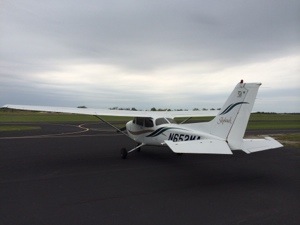
Saturday was a good day to fly to Lockhart with Lauren for BBQ.


Saturday was a good day to fly to Lockhart with Lauren for BBQ.
Inventing the future of reading:
The next day I flew to Silicon Valley and visited Amazon Lab126, the Amazon subsidiary that develops all of the company’s Kindle products. A tremendous amount of thought and research has gone into these devices. At Lab126 there is a “reading room,” where test subjects are asked to read on various devices for hours at a time. They are filmed and studied. People reading in a chair will, naturally, hold their Kindle differently from people standing up (on the subway, for example), but even people sitting in a chair will shift their positions over time. Eighty percent of page turns are forward, by the way, but 20 percent (20!) are backward. On the conference table before us were the dozens of iterations of possible page-turning buttons for the new Kindle Voyage, buttons that would have been on the back of the Kindle, a switch button, and also arrows alongside the screen—a > for forward and a < for back—the most visually pleasing design and by far the most intuitive, but then in testing it turned out that people liked to turn the Kindle and read horizontally, which meant that the arrows were pointing, confusingly, up and down. (The designers settled on two sleek lines for forward and two cool dots for back.)
A few minutes after landing at Brenham Municipal Airport, I’m greeted by a cheerful waitress in a poodle skirt. She leads me to a booth at the airport’s 1950s themed diner, not minding that I’m distracted and weary from a gamey landing that included a gusting and wavering crosswind. Like all experiences that are both challenging and rewarding, the crosswind nudges me out of my comfort zone.

I order lunch as two men who appear to be in their 70s discuss aviation fuel prices from the booth next to me. The Brenham Airport Diner is one of two themed diners frequented by pilots and aviation enthusiasts in Central Texas. The other, Gillespie County Airport, is 130 miles west of here and features a theme that pays tribute to the Pacific Ocean theater of World War II.
As I take in my surroundings, I wonder if my generation will produce enough pilots to justify airport theme diners.
After lunch I preflight and fuel the airplane. The winds have calmed some, and the area weather stations report that clouds are continuing to rise into the autumn sky. The Cessna climbs rapidly in the cool air, cutting through the wind, toward home.
August is a great time to leave Texas. For pilots especially, summer presents unique challenges. High temperatures and humidity contribute to bumpier, often less enjoyable flights. These conditions also diminish aircraft performance, resulting in longer takeoff and landing distances and reduced fuel efficiency.
Of course, these issues aren’t particularly difficult to deal with. Perhaps the hardest part for me is the time spent on a smoldering airport tarmac for pre- and post-flight operations.
In Austin especially, the months of August and September are not kind to Midwesterners.
For these reasons I was anxious to escape with Lauren to California. Sonoma County is a good destination for anyone seeking chilled air. We decide that before setting out on a fast and furious tour of areas wineries, we’ll kick-off the trip by logging some local flight time in Napa. It would be our first experience in flying out-of-state since I earned my pilot certificate in 2012. (more…)
We set out on Saturday, February 8 for a dusk flight over Central Texas. Lauren captured this approach into Lockhart just as the sun was setting.

 Michael Castellon