Month: March 2006

  • Spring cleaning for your PC

    During the winter months it’s likely your computer has become sluggish and glitchy while you’ve been indoors browsing the Web and downloading annoying forwards from your friends. A PC that doesn’t receive routine maintenance, even in just a couple months, can experience a severe reduction in performance and reliability.

    Much like how your house accumulates useless clutter and dirt over a period of time, so does your computer. That’s why it’s important to do a thorough overhaul every once in awhile – the same way you might clean out the closets, refrigerator, and from under the couch. A deep clean for your PC will also give you a better outlook and a higher sense of Chi, just like cleaning out the garage.

    So let’s get started.

    The first thing you’ll want to do is run your Disk Cleanup utility, which is a program you already have in Windows XP. Disk Cleanup is a utility that’s a bit like hiring an inexpensive maid for your home just before guests arrive: it’s not enough to have by itself but it puts you in a good place to tackle other important larger tasks.

    You’ll find Disk Cleanup under the Accessories -> System Tools folder in your Start Menu:

    It’s safe to check all the options in this window. If you’re in doubt, however, leave the item unchecked and click OK.

    Disk Cleanup can run kind of slow, especially if your computer is bogged down with a lot of junk. But be patient and let the cleanup run its course. The more junk files you have the longer it’s going to take this application to do its job. Running Disk Cleanup will make a good starting point for us to conduct a few other crucial tasks.

    Next, let’s go ahead and defrag that hard drive. Running Disk Defragmenter, which is also on your computer if you’re using Windows, is one of the most important things you can do to have a clean and healthy hard drive. It works kind of like an interior decorator by putting important and useful things in key area and making your basic overall computing experience will go way up. So let’s run it:

    You’ll find Disk Defragmenter right next to wear you found Disk Cleanup – in your Accessories -> System Tools foler in your start menu. Go there now and click on the link. You should have this window open now:


    Go ahead and click Defragment and let the utility run its course. It might take some time, especially if it’s been awhile since you’ve done this. Even longer if you’ve never done this. It’s not unusual for a heavily fragmented hard drive to take a few hours to defrag, but your computer will love you for it.

    After you’ve defragged, let’s go to the next step, which is to scan your computer for virus, and to protect it from future attacks:

    I’m a big fan of AVG Antivirus. It’s free, it’s reliable, and it’s better than a lot of the high dollar antivirus utilities you could buy. Go ahead and download it and follow the program’s installation and scan instructions. From now on, it’s important you keep AVG Antivirus up to date. Doing so will keep you nice and clean and will prevent the heartache of having a hard drive become unusable due to a virus attack.

    We’re almost done. Let’s do one more thing that’s crucial to a healthy computer:

    Let’s sweep your hard drive of all the little bits of data and junk files your computer accumulates when you use the internet. The best piece of software you can use for this is Lavasoft Ad-Aware. Again, it’s free and reliable. Go ahead and download it, update it, and let it scan. It’s likely safe to delete everything it recommends. Again, if you’re in doubt about a element that this utility finds, un-select it and don’t let Ad-Aware delete it.

    You’re best bet is to let these procedures and utilities do their job as often as possible. Each one dramatically reduces your chances of having a really bad, preventable computer problem. Oh, yeah. And make backups of your data as often as possible.
    michael castellon
    mike castellon
  • Why AOL is still a miserable experience

    A few weeks ago I decided to install the newest version of AOL Instant Messenger on my laptop at the request of Kevin Rose who wanted to chat about the discovery of a technical glitch on Digg.

    Although I configured the setup utility to install only AIM and none of the other malware AOL tries to install by default, it still installed their miserable browser, which automatically set itself as the default browser for several apps including the Flickr image upload utility.

    The browser would start itself at random times – especially when I was doing anything involving AIM or Flickr.

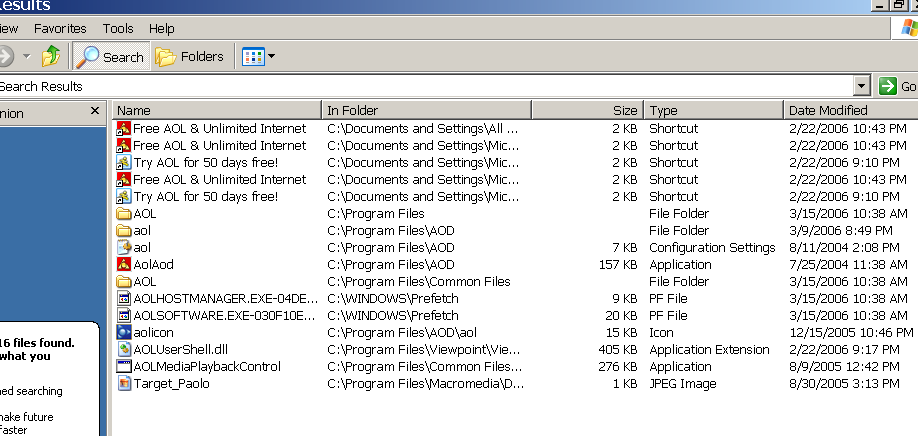
    Naturally, the AOL browser doesn’t show up in the Windows Add/Remove Programs utility. Instead, only the AIM program itself does. After finally getting angry enough to uninstall AIM in the hope of getting rid of AOL’s trash browser, I decided to search my hard drive for AOL programs, and saw that all these files were still embedded in my computer. I stress the fact that files were found on my computer after I uninstalled every AOL program using it’s uninstaller.

    (click to enlarge)

    Before anything else, I visited AOL Tech Support’s Website for assistance. Naturally, this is the page that comes up when you click on a button that offers help on uninstalling AOL:

    If you want to do yourself and your computer a favor, stay far away from anything with the AOL brand.


  • First full length feature movie now available at iTunes

    In what may be a hint that Apple (finally) releasing a full-blown video iPod in the very near future, the iTunes music store has made available it’s first full-length feature movie.

    High School Musical (more) is a 1 hour and 39-minute Disney Channel original production that was quietly posted to iTunes in the past day or so. The movie is almost 500MB big and costs only $1.99 which is about the same as all other videos on the iTunes Music Store. iTunes link

    It remains unclear if this will is a price point for movies in similarly situated genres – or a promotional price to encourage movie downloads for the upcoming iPod.


  • I’m featured on Geek News Central

    You can imagine the look on my face when I heard one of my favorite podcasters, Todd Cochrane of Geek News Central, give my post on backing up Gmail a shout-out on his show.


  • ‘Happy face’ photographed on Mars

    From Malin Space Science Systems:

    There are a number of Viking Orbiter images of Mars that, from time to time, have been invoked as examples of landforms that look like familiar objects. On of the better examples is the crater Galle (51.1° S, 31.3° W; 215 km across), located on the eastern margin of the large basin Argyre. The “face” was first noticed in synoptic observations taken early in the Viking Orbiter 1 mission. (more)

  • Google to sell ebooks?

    This is news. As if their rececnt ventures into video, chat, email, and webpages weren’t enough, it now seems that Google may be preparing to dive into the ebooks market:

    Google is inviting UK and US publishers to sign up for a forthcoming e-book store on its website.

    Users will get access to purchased book through their browser only, and will not be allowed to save local copies of the book or copy pages.

    “Google Book Search helps users who find and preview your books buy them through online retailers, local bookstores, and soon, will let them pay for immediate access to them right from their browser. It’s a way for publishers to experiment with a new method of earning money from their books in addition to those that already exist,” the search engine said on a webpage where it invites publishers to sign up for the service.

    The service is part of Google’s book search, a feature that lets users perform search queries against texts published in books. The service presents users with fragments from the books and in some cases links online retailers. But so far it doesn’t provide direct access to the works.

    This may be a logical step for Google. It’s no surprise the mega-company will some day be in posession of all the world’s data. But recent lukewarm responses to some of Google’s recent endeavors raises some questions about how this service will be executed.


  • How to maximize your cable/DSL performance using Windows XP

    Here’s a handy guide to tweaking some Windows XP setting that should help you get the most out of your broadband connection:

    • In the “My Network Places” properties (right-click on the desktop icon and choose properties), highlight the connectionthen at the menu bar choose “Advanced” then “Advanced Settings”. Uncheck the two boxes in the lower half for thebindings for File and Printer sharing and Client for MS networks. Click OK.
    • From the Windows XP CD in the support directory from the support cab, extract the file netcap.exe and place it in adirectory on your hard drive or even in the root of your C: drive.
    • Next, open up a command prompt window and change directories to where you put netcap.exe. then type “netcap/?”. It will list some commands that are available for netcap and a netmon driver will be installed. At the bottom you willsee your adapters. You should see two of them if using a 3Com card. One will be for LAN and the other will be forWAN something or other.
    • Next type “netcap/Remove”. This will remove the netmon driver.
    • Open up Control Panel->System->Dev Man and look at your network adapters. You should now see two of them and one will have a yellow ! on it. Right-click on the one without the yellow ! and choose uninstall. YES! You are uninstalling your network adapter, continue with the uninstall. Do not restart yet.
    • Check your connection properties to make sure that no connection exists. If you get a wizard just cancel out of it. Now re-start the machine.
    • After re-start go to your connection properties again and you should have a new connection called “Local area connection 2”. Highlight the connection, then at the menu bar choose “Advanced” then “Advanced Settings”. Uncheck the two boxes in the lower half for the bindings for File and Printer sharing and Client for MS networks. Click OK.
    • Choose connection properties and uncheck the “QOS” box.
    • Re-start the machine. (thanks to tunexp for these steps)

    It’s highly advised that you check with your ISP to make sure it’s Ok to self-bump your broadband speed. Some providers don’t like it when you do that.

  • Did you know … ?

    That MC Hammer has a blog? You can tell by some of his content that he reads other people’s blogs.

    For example, he has the obligatory emo-esque self portrait taken in the mirror with a camera phone.

    The site’s design hints that this might be a fluff promotional site put up by Hammer’s handlers. It has ads and uses a pretty slick design.